Most people assume salt is simple. You mine it, you bag it, you ship it. The reality is a bit more involved, and understanding the process helps buyers make smarter sourcing decisions.
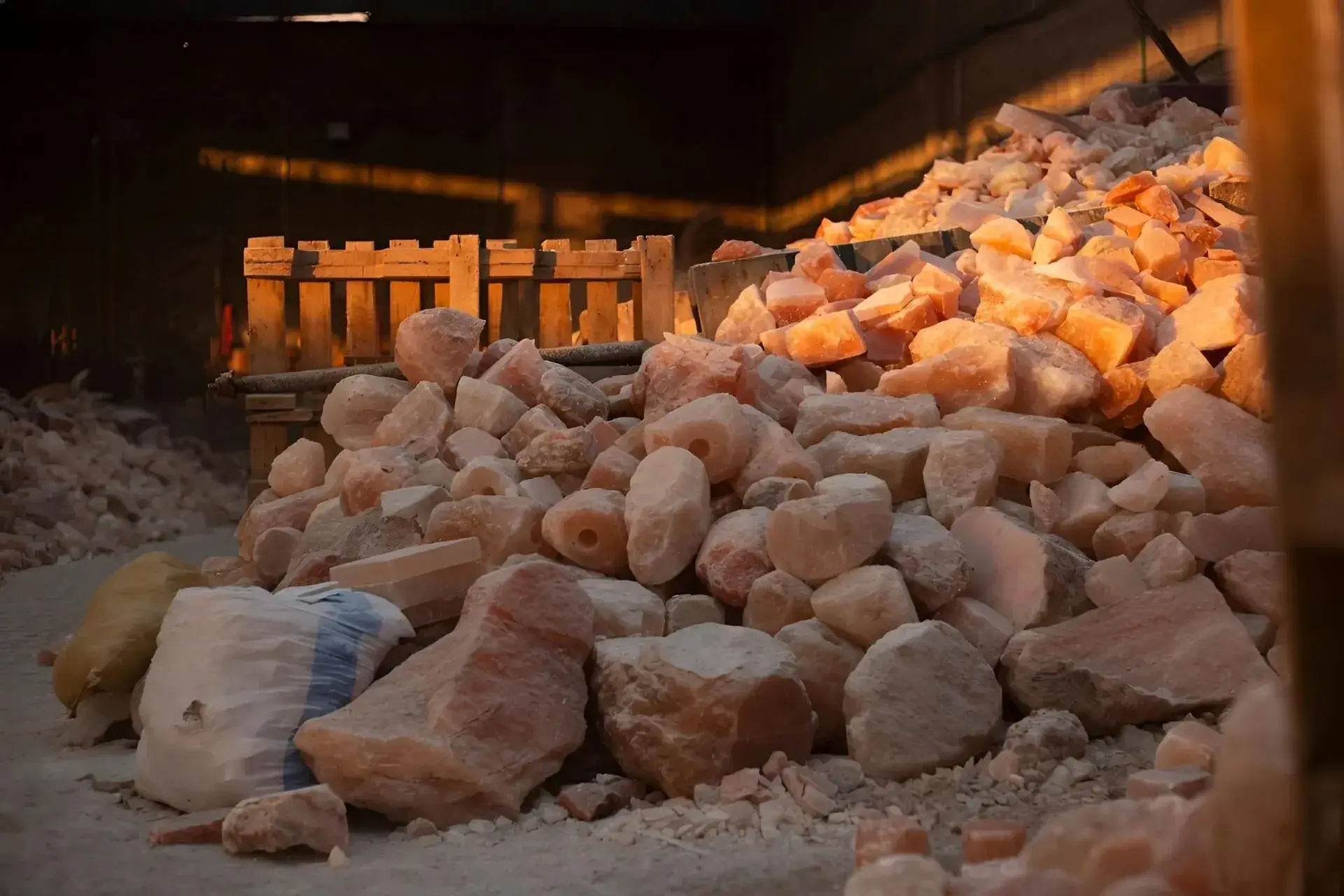
The journey begins roughly 160 kilometers from Lahore, inside the Khewra Salt Mine. Miners extract salt blocks from tunnels that stretch deep into the mountain. Not all of it is pink, and not all of it qualifies as export grade. A significant portion of raw extracted salt is immediately sorted out — too gray, too dark, or too contaminated with surrounding rock to meet food safety standards.
What passes the initial sort moves to a processing facility where it is washed, dried, and milled to the required grain size. Fine grain for table use, coarse for grinders, extra coarse for cooking slabs and bath applications. The milling process is straightforward but the tolerance is tight — grain size consistency matters enormously for private label clients who are filling branded grinders that need a predictable pour.
After milling, the salt goes through a sieving and magnetic separation pass. The magnetic step removes any trace iron particles that may have entered from processing equipment — not from the salt itself. This is a standard step in food-grade production and is part of what makes HACCP certification meaningful rather than just a piece of paper on the wall.
Packaging follows. Most export orders go into food-grade polypropylene bags — 25kg and 50kg are the most common for bulk buyers. Retail orders that include private label work add a labeling stage where the client’s branding is applied before the product is sealed. This is where lead time extends slightly, because a label proof has to be approved before production runs.
Before a container is sealed and loaded, a quality control sample is pulled from the batch. Depending on the destination market, this sample either goes to an in-house check or is sent to a third-party lab for heavy metals testing, microbiology, and moisture content. The EU market, in particular, is strict about documentation — every shipment needs a certificate of analysis, a health certificate, and in many cases a certificate of origin.
The container is then loaded and moved through Lahore or Karachi port depending on the routing. Transit times to Western Europe average three to four weeks by sea. The Gulf is closer — sometimes under two weeks. The USA east coast runs five to six weeks depending on routing through Suez.
When it arrives at the destination port, the paperwork the exporter prepared determines how smoothly customs goes. An experienced exporter has done this enough times to know which documents each country’s customs authority will ask for before they ask for them. That preparation is what separates a smooth delivery from a shipment that sits at port for two weeks while someone hunts down a missing form.
That is the journey. It is not complicated, but every step has a place where corners can be cut — and the buyers who know this are the ones who ask the right questions before placing an order.